A Launcher cannot follow you into every text field.
RETUI could change how the home screen felt, but the moment I started typing in another app, Android handed the experience to a completely different keyboard. Keys exists because that handoff kept feeling like leaving the project behind.
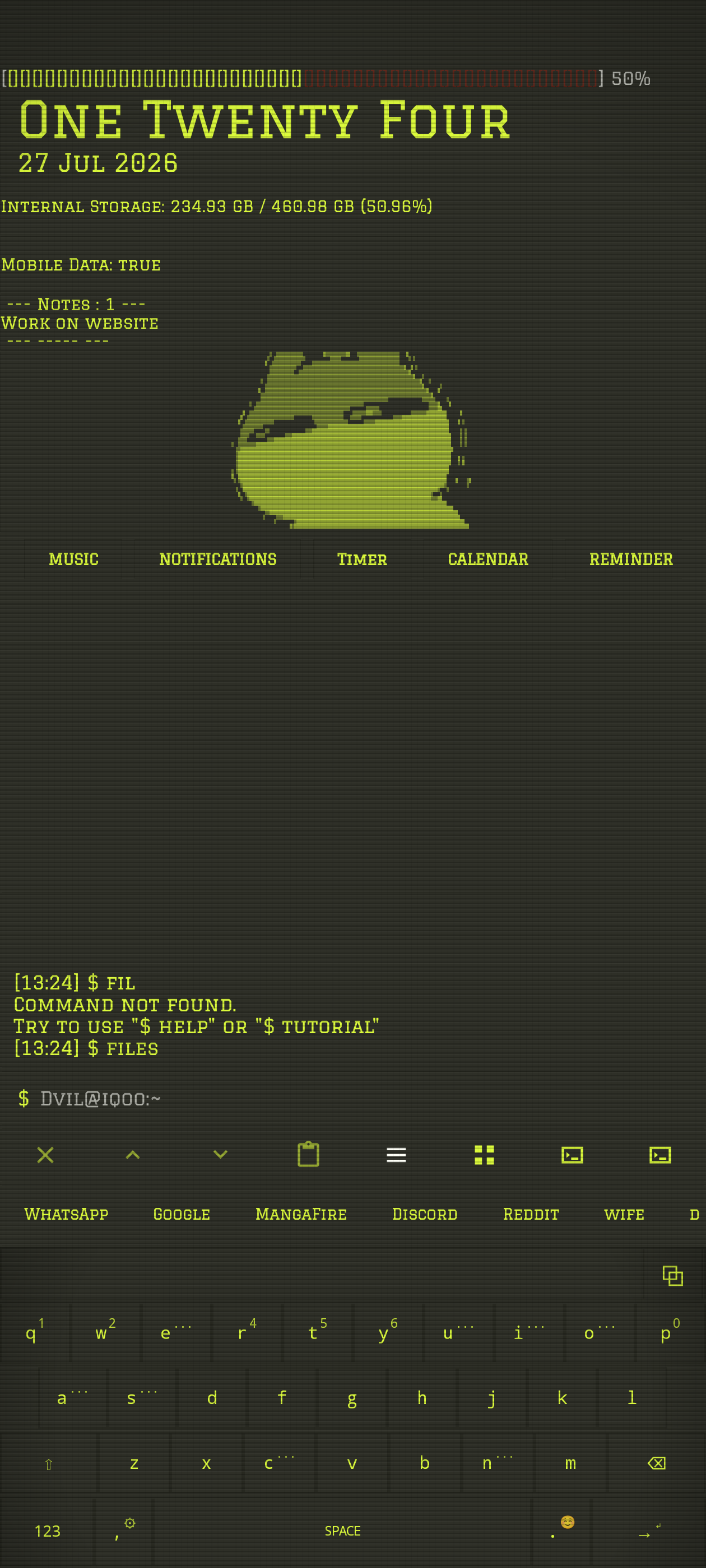
Green means RETUI travels with the cursor
RETUI Keys is a real Android input method, package com.dvil.retui.keyboard. It is not a keyboard drawn inside Launcher and it does not need Launcher to be running. Once enabled, it can appear anywhere Android accepts an input method.
That independence matters. Launcher, Files, and Keys share a visual language, but each one owns a different part of the phone. Keys owns typing.
I wanted terminal keys without turning every message into terminal work
There are QWERTY, number, and symbol layouts, plus the keys that become oddly difficult to find when a phone is doing serious terminal work: ESC, TAB, CTRL, ALT, SUPER, arrow keys, and DEL.
Those controls sit beside ordinary keyboard behaviour. Shift can be used once or locked with a double tap. Long-press opens alternate characters. A number row, arrow row, quick period, and split landscape layout can each be turned on when useful.
ESC  TAB  CTRL  ALT  SUPER

write a shell command
reply to a message
name a file
search any app
The point is not to force a command line into every conversation. It is to stop losing useful controls just because the terminal happens to be on a phone.
The suggestions stay on the device
A keyboard sees an uncomfortable amount of your life. I did not want RETUI Keys sending typed text to a hosted model or quietly building a profile somewhere else. The app does not request Android's INTERNET permission.
Suggestions combine a small built-in vocabulary with words learned into a local dictionary. Frequency and recent use help with ranking, and the keyboard follows the casing of the word being typed. Unknown words can be added manually instead of disappearing into an invisible service.
The dictionary remains visible in settings. Words can be added, inspected, removed, exported to a JSON file, and restored through Android's file picker. Android cloud backup and device-transfer extraction are disabled, so an export only happens when the person using the keyboard asks for one.
Glide typing can be local too
Glide typing is experimental, but it follows the same rule. The trace is ranked on-device against the local word data and an offline language model. There is no server waiting to interpret the path.
The emoji picker is local as well, built from the Unicode emoji list with categories and recent choices. Long-press the period key to open it, then return to the main layout without leaving the keyboard.
I do not expect a young open-source keyboard to outguess years of data collection overnight. That is the honest trade-off. I would rather keep improving something understandable than make privacy depend on a promise hidden behind network access.
A clipboard shelf should not become another cloud
Keys includes a clipboard mode for saving, pasting, removing, and clearing text entries. Automatic capture is optional, and retention can be limited so old entries expire instead of accumulating forever.
The shelf is stored locally with the rest of the keyboard data. That does not make clipboard content harmless, but it keeps the decision close to the device and gives the user controls that can actually be seen.
The Launcher can pass the atmosphere, not take control
When Keys is used with RETUI Launcher, Android's standard input-method channels can pass the active colours, borders, text treatment, cyberdeck style, and CRT setting into the keyboard. Keys stores the latest snapshot locally and uses it across apps.
Without Launcher, it falls back to its own terminal defaults. Colours can also be overridden in the keyboard settings, alongside height, margins, character size, key spacing, corners, stroke width, vibration, sound, and a background image.
This is the relationship I want across RETUI. The apps recognise each other, but none of them becomes useless when another one is missing.
Keys made RETUI larger than the home screen
Launcher is still where this project started. It is not where the project has to stop. Files gave storage its own yellow space. Keys gives typing a green one, including the moments when Launcher is nowhere on screen.
RETUI Keys is not the Launcher stretched into another shape. It is the part of RETUI that appears wherever the cursor is waiting.